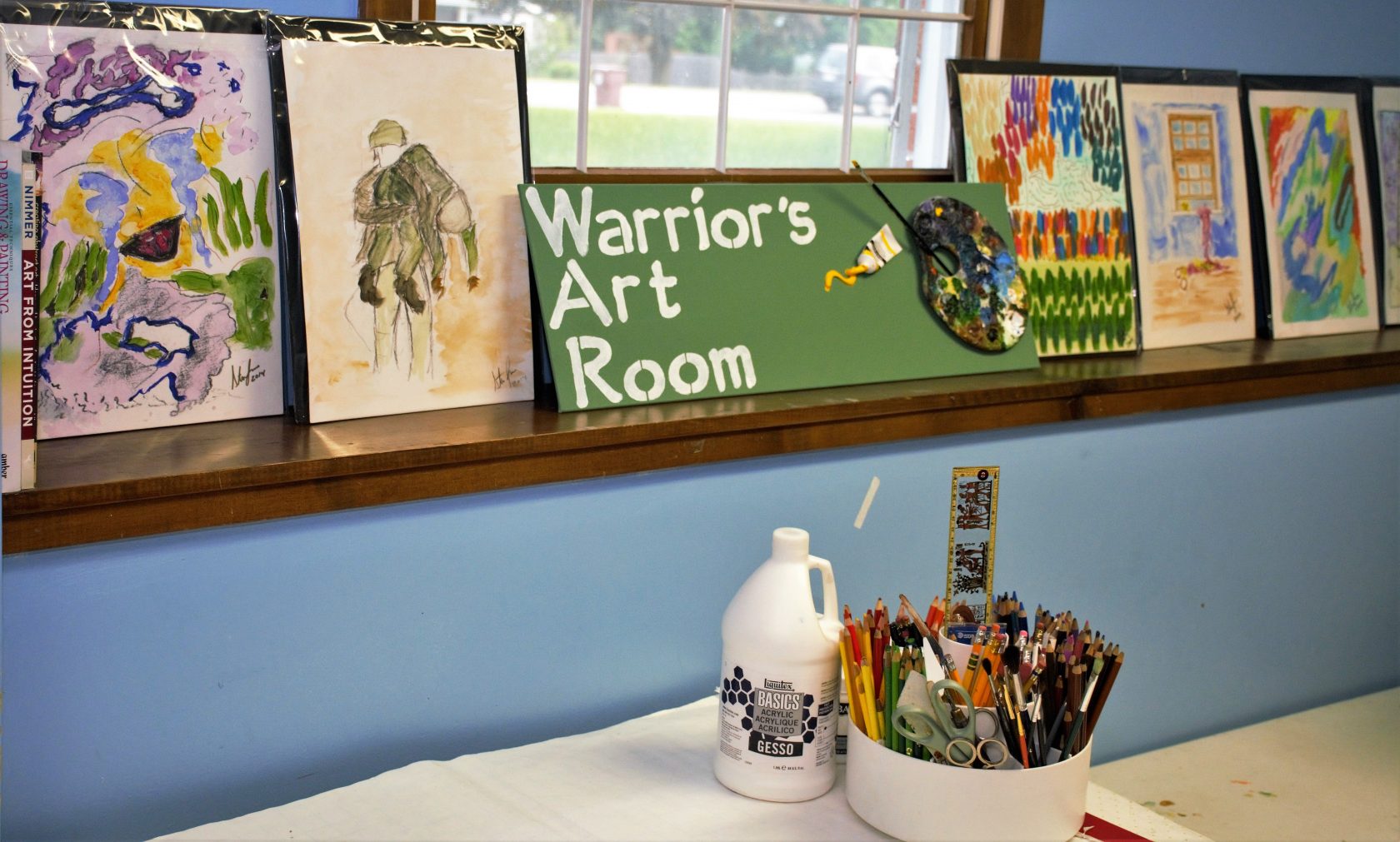
WESTFIELD–After Marine Corps Sgt. Steven Jones returned home from Iraq, he couldn’t shake his recurring feelings of sadness and hopelessness.
Jones, who served in the Marine Corps Reserve for eight years, had dealt with the emotional trauma that most veterans face in wartime. During his time in Iraq from 2004 to 2005, he directed air support in the Iraq region, helping to orchestrate where aircraft were and where they needed to be. His experience there included two of the deadliest incidents in the Iraq War–second battle of Fallujah beginning in Nov. 2004, and Jan. 25, 2005, when the US had lost a helicopter that was to pass through Jones’ airspace.
During the second battle of Fallujah, Jones heard the sounds of war. Men screaming for their mothers, panic, bullets ripping through the air and ripping through his brethren. He wasn’t there to see the events, but only experienced them through sound from the battlefield, as he attempted to provide support for his fellow troops. 95 US troops died during the battle.
“I had 7 minutes to get a helicopter off the ground or they weren’t coming back alive,” Jones said. “And you couldn’t get everyone back alive, especially in the battle of Fallujah.

A drawing inspired from Jones’s time in Iraq.
“I couldn’t see what was going on so my visual was what my mind imagined, and in some ways that may even be worse because I’m just imagining what is going on there.”
Then, on Jan. 25, a helicopter carrying 31 US troops came through the Anbar region of Iraq, and were supposed to reach the airspace that Jones was responsible for and contact him. When Jones didn’t hear from them, the panic began to set in. Jones said the requests on their status filtered to him and he had no clue where they were. The crews began searching for the helicopter, hoping that it wasn’t down. After all, as Jones said, it wasn’t uncommon for helicopters to fly through an airspace and not contact the one in charge of the area.
But the helicopter was found crashed in the Anbar region. All 31 on board died. It was the deadliest single incident for the US in the postwar efforts.
Jones dealt with these deaths and struggled, but continued to push through, eventually finishing his tour.
When Jones returned back home the feelings of hopelessness and sadness began to creep in, and seemingly innocuous events and senses would trigger them.
“I would be driving to work, and by the three-county fair there’s a water treatment plant, and that smell would bring me back and I would think ‘these guys aren’t coming back’,” Jones said. “And I would be so hopeless, I wouldn’t even be able to lift my head up.”

A painting by Jones, inspired by his emotions before and after painting.
Jones continued to struggle with these emotions, finding them creep up especially during the anniversaries of the incidents. He tried to get help through the Department of Veteran’s Affairs (VA), but to no avail.
“I had trouble sleeping and went to the VA and they instantly wanted to put me on drugs and I didn’t want that so I left,” Jones said.
Jones continued to work, doing a job for C and S Wholesalers, while dealing internally with his emotions.
Then eventually, in the midst of it all, Jones went back to school. He knew he was unhappy and wanted to change his career to help veterans like himself, so he began by pursuing a psychology degree at Holyoke Community College. While there, he had to go through what many college students do–the humanities.
This is where he first came in contact with art.
“Through the creation of art I found that when I was feeling sad I could draw or paint and those feelings would go away,” Jones said. “And at that time I met a professor named Dean Nimmer, and he taught me to essentially put my feelings out on paper and canvas, instead of creating something in the real world, and he taught me abstract.
“He taught me that it’s not the end result that mattered, but the process of creating it that was important.”
Jones began using art as therapy, continuing to cope with his negative emotions and putting them on canvas, paper or any other surface that accepted art. He even began to deal with everyday stresses through out, finding out that it worked for those, too. And he also saw that other veterans in his class were experiencing the same benefits to art as he was.
This inspired him.
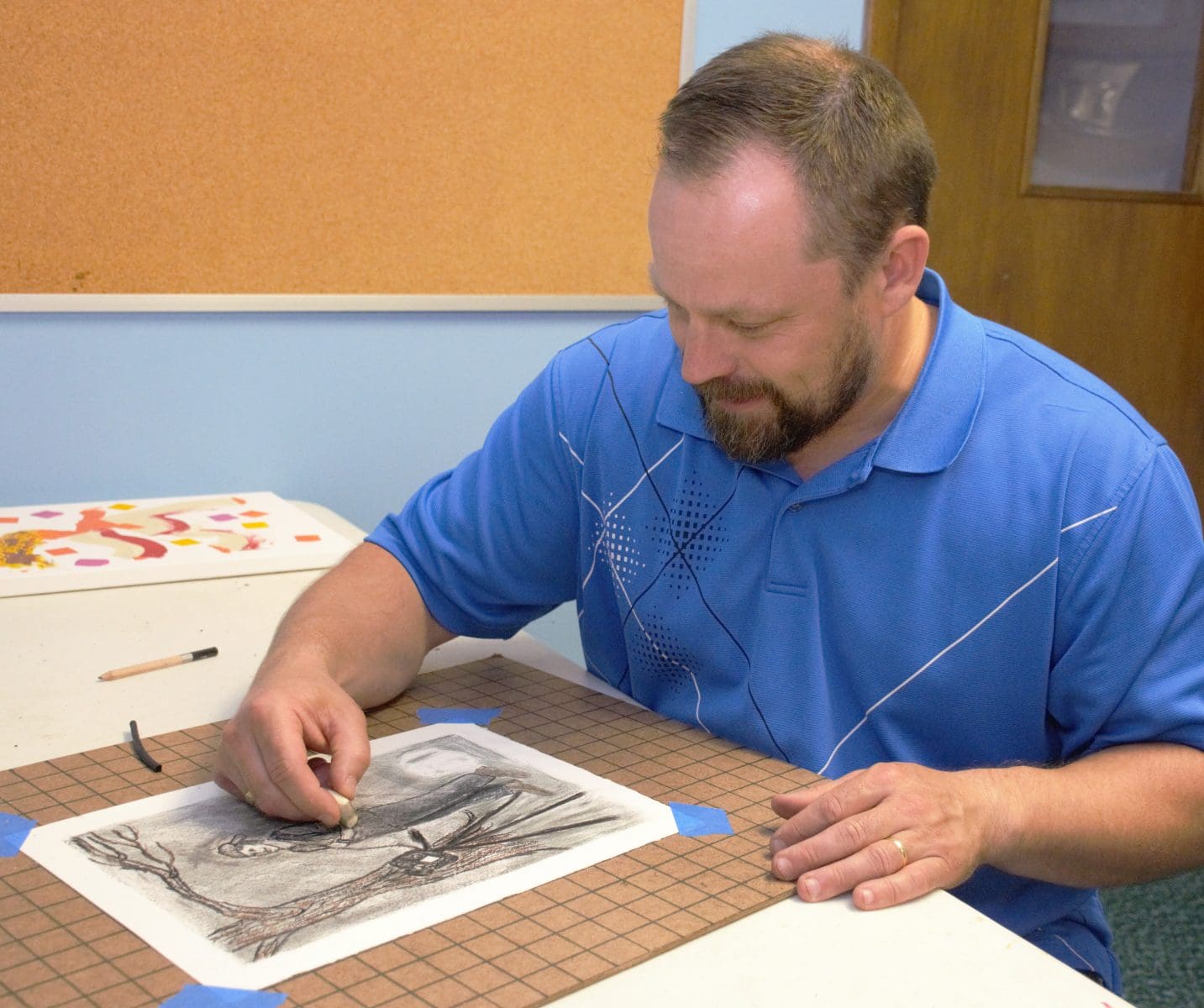
Jones using charcoal to draw.
Jones decided to create Warrior’s Art Room, a nonprofit dedicated to helping veterans and their families through the creation of arts. This may be painting, drawing, sculpture, poetry or music–the medium doesn’t matter. What matters is helping.
“I found through that method of painting and art I was healed of my sadness and hopeless feelings, so I figured I would bring that experience to veterans as best as I could,” Jones said of the project. “So many people and veterans are addicted to drugs and alcohol and this is a perfect way–it worked for me, anyway–to combat those feelings.”
The effort is a family affair for the Jones. His wife Brenda helps however she can, and learned art alongside her husband in the process.Her artwork can be found on hand-painted “Thank You” cards, along with her husband’s work at the Westfield Art Walk June 4.

Brenda Jones painting hand-made “Thank You” cards.
Additionally, their daughter ShyAnne joins them in the art studio regularly, and Steven describes his daughter as “my art partner.” His other two children, sons Joseph and Thomas, don’t partake in the arts, but are following their father in his footsteps as a member of the armed forces.
Jones has big visions for Warrior’s Art Room. He hopes to develop it one day into a studio for all of the arts, and eventually have more teachers and a place to display the art done by veterans. But for now, he is content in the basement of First Alliance Church on 297 Russell Road, in Westfield, where the church provides the space for free.
“The outpouring of the community is great, everyone seems behind it. The issue now is the outreach to other veterans. Everyone knows a veteran,” Jones said.
Jones and his family will be at the Westfield Art Walk June 4, in addition to other art events in the city. They will be selling their works to help continue to grow Warrior’s Art Room, but are also seeking support from those in the community.
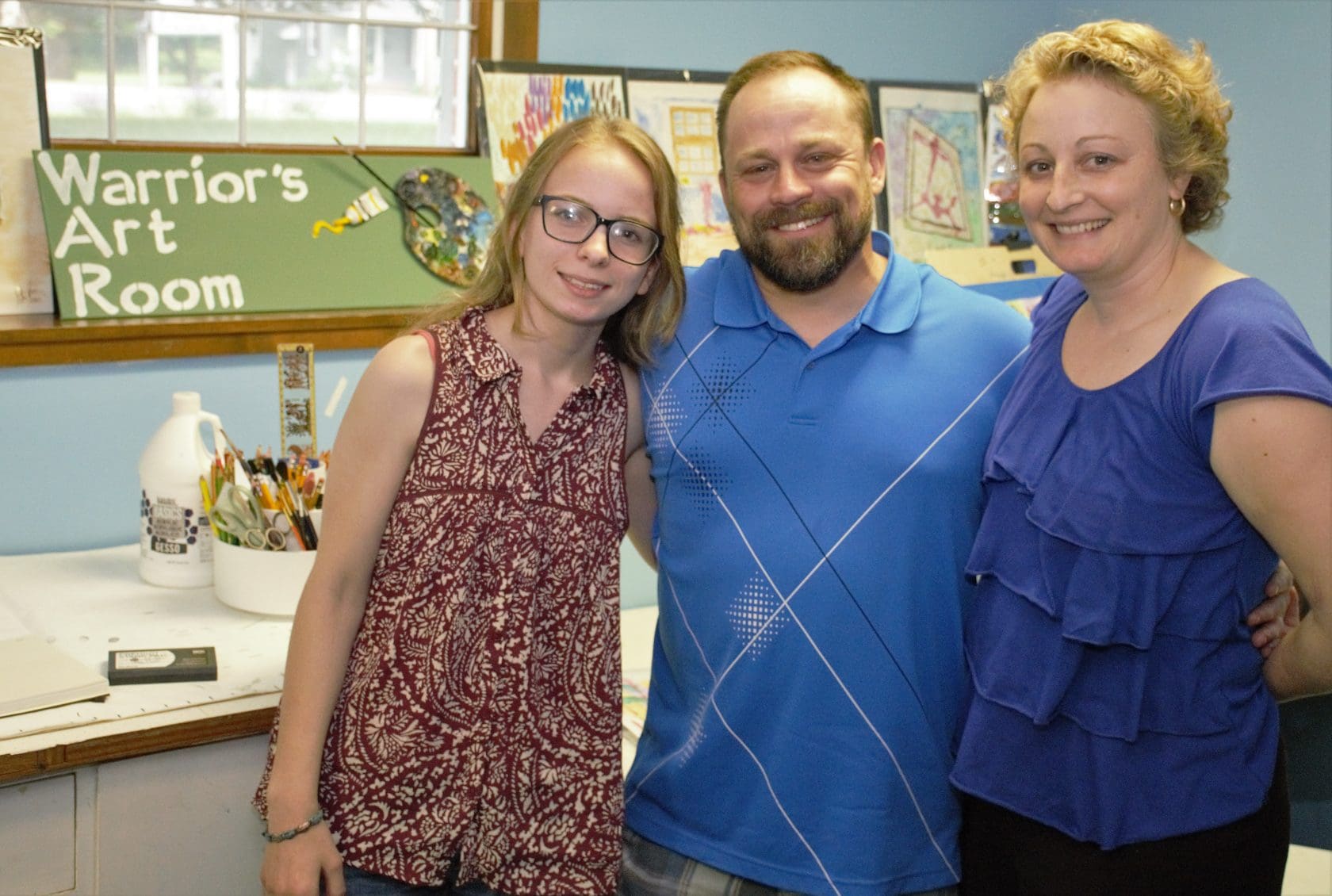
Portion of the Jones family (from left to right): ShyAnne, Steven and Brenda.
For more information, whether you want to donate, want to make art and you’re a veteran of a family member of a veteran, or if you want to help, find Warrior’s Art Room on Facebook. Otherwise, you can email Steven Jones at [email protected], or call him at (413)627-8170.