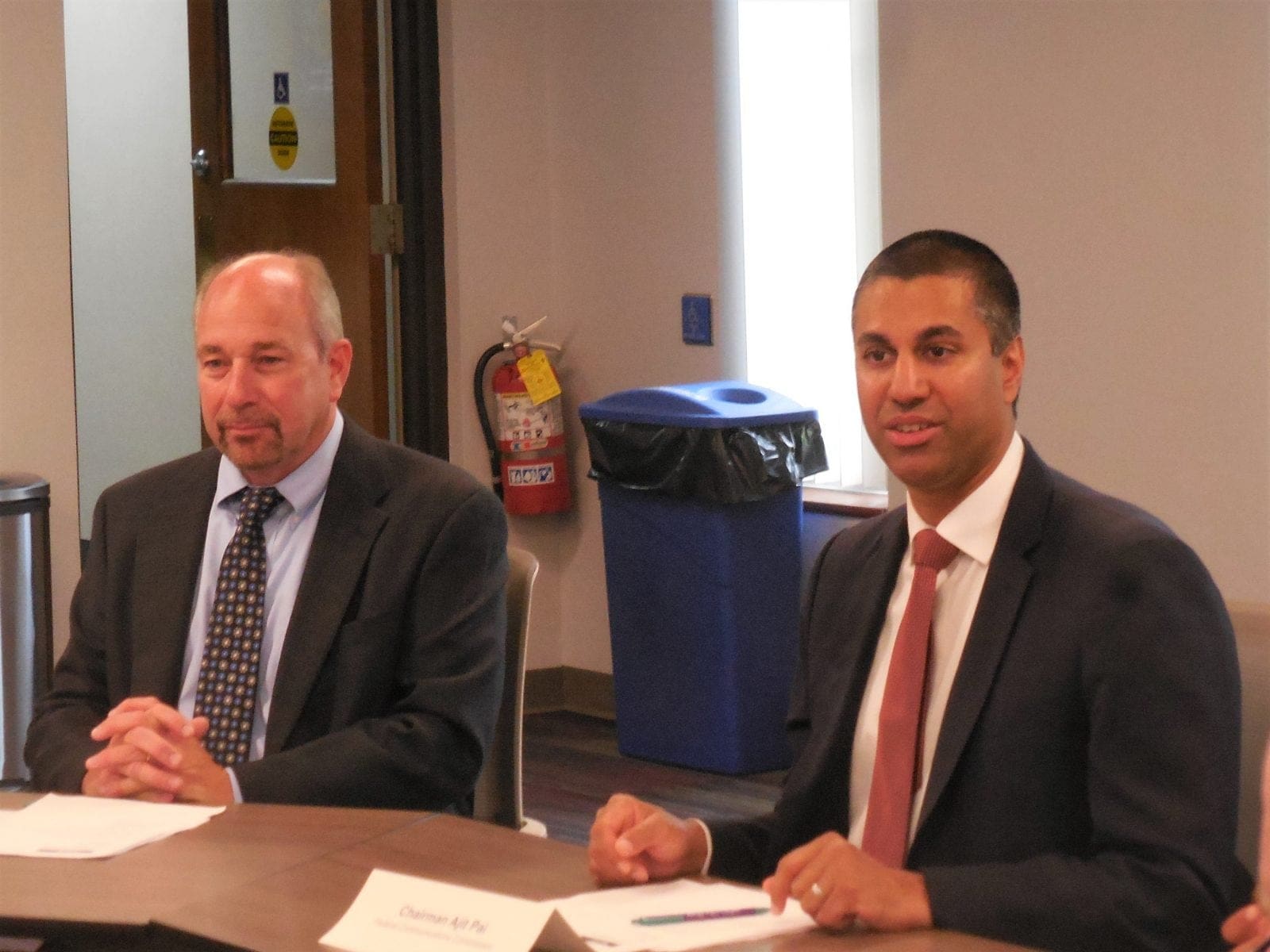
WG+E General Manager Daniel Howard and FCC Chairman Ajit Pai during a visit by the federal agency to Westfield on Tuesday. (Photos by Amy Porter)
WESTFIELD – On Tuesday, Westfield Gas & Electric had a second visit in three weeks from public officials interested in what the Municipal Light Plant is doing to help bring broadband to unserved areas in the hilltowns. Federal Communications Commission Chairman Ajit Pai came on the heels of a visit from Governor Charlie Baker and Lt. Gov. Karyn Polito on Aug. 23 to meet with General Manager Daniel Howard and Whip City Fiber employees, and learn about their progress.
Before the meeting, Douglas McNally who serves on the Select Board and MLP board in the town of Windsor, said it would be impossible to connect without the help of WG+E.
“From a small town’s perspective, it would be impossible to do without their help,” McNally said, adding that the town of 890 has only three full-time employees on the Highway Department.
McNally said the town is now working with WG+E to put out an invitation to bid to lay the fiber. The design work is done, and they are joining 14 other towns in buying pre-fab concrete huts, that the electric company was able to buy in aggregate at a cost savings of $5,000 to $10,000 per unit.
McNally said that the FCC Chairman is interested because it is an unusual model, MLP to MLP. Each of the 21 towns that the company is working with will own their fiber network once it’s completed. The consortium also recently won a grant of $1,032,540 from the FCC’s Connect America Fund, which will go to the towns to help pay for expenses. The grant is for unserved communities, so Westfield did not quality.
G+E General Manager Dan Howard said WG+E assisted the towns with the CAF grant as an aggregate. “It’s better to go through it collectively than individually,” Howard said. He said the 10-year grant will give the towns the same amount of money every year for 10 years. “It’s going to help keep the costs down. The FCC is coming to see the effect the grant has on the towns,” he added.
“All these people in this room played a part in the hilltowns,” said Howard at the start of the meeting, as Whip City Fiber staff, local and state representatives were introduced.
Whip City Fiber operations manager Aaron Bean and EOHED community liaison William Ennen.
Whip City Fiber Operations Manager Aaron Bean said the part they played was a project management role, for which they have signed Intergovernmental Agreements with the 21 towns. Bean also said after laying fiber optic for 20 years, the company started its effort four years ago to bring Whip City Fiber into homes in Westfield. “Now we can bring networks to fruition,” he said.
Christopher LaVerta, who is charge of the procurement effort for the towns, said they help buy materials they don’t have in bulk, and sell them other materials they have on hand, such as fiber. LaVerta said WCF doesn’t do the work in-house, except for smaller projects. They project manage construction, invoicing, and make ready work. LaVerta said the cost to the towns for them to serve as project manager is minimal, covering WCF’s costs.
After the towns are connected, if they want to stay, Whip City Fiber can serve as internet service provider and network operator for the towns. WCF would operate as billing agent and providing service, creating bills on behalf of the towns and sending them out to customers who will be paying the towns for the service.
To date, WCF has agreements with two towns, Otis and Alford to serve as ISP. Most of the towns are still under construction, and not yet at the point to select an ISP.
Ajit Pai asked the group if there was positive feedback from the folks in the towns. He said he is from a rural town in Kansas that is facing many of the same issues as in Western Mass.
David Kulp, MLP manager for the town of Ashfield, which has 1600 residents and 850 homes, described the significance to his town by saying they had a massive turnout to vote for the biggest project in the town’s history.
William Ennen, community liaison for the Massachusetts Broadband Institute of the Executive Office of Housing and Economic Development, said the turning point for the effort was in 2017, when representatives from the towns told MBI they wanted to work with WG+E. He said after that they built the last mile initiative program around WG+E. That allowed the towns to come to the state and apply, and set up with WG+E as project manager in a unique collaboration of local government, state government and federal government.
Looking at the map of the towns beings served, Pai asked why some were in non-contiguous areas. Ennen replied that each town went through an elaborate process. He said they might have liked the WG+E model, but couldn’t come to terms with borrowing for their own networks, and chose to go with another provider that would own the network, such as Comcast or Charter.
“What we do is to mitigate problems. Every quarter, the Lt. Governor hosts a summit with all of the principals, which she started in the first quarter of 2018,” said Bean.
Ennen said every Thursday there is also a call between the towns and providers, which go “pole to pole.” He said they have had successful interventions, such as 39 poles in Shutesbury that were holding up the progress in that town, and they were able to move up the Eversource timeline by 4 to 6 weeks.
Joseph Parda, WCF project engineer, said things were “moving along pretty rapidly” on the engineering and design side. He said the processing on the WCF side was relatively easy, although there have been some difficulties in working with the utilities on the poles.
Bean said they are keeping track of every appointment, time, dates, and when the work is estimated to be completed. Parda said they have been working on it for a year, but events like hurricanes and storms come up which can slow things down. He said they responded to four storms last year, and crews also went out from Eversource and Verizon on mutual aid calls.
Ennen called it a “truly collaborative effort.” He gave the example in the town of Windsor, where they had to plan to spend one-third of their budget on an unknown number. “This team intercepted make ready invoices before going to the towns; if they see high numbers, they call. In one town, they saved $110,000.”
Bean said being a utility themselves, they can speak to other utilities.
“If we at FCC can be of assistance, let me know,” said Pai.
Douglas McNally of Windsor and Whip City Fiber IT Architect Richard Carnall.
Richard Carnall, senior fiber architect said he was tasked with looking at the Connect America Fund process, which was held as a competitive auction to bring prices down. He said the consortium was able to get prices at 78.35%. He also said he couldn’t say enough about how helpful and responsive the FCC had been. “It was a great process, and very helpful on your staff’s part,” Carnall said.
Ennen said the town representatives have been working on this project for the past six to eight years, and wanted to anticipate the CAF funding in their proposals, but couldn’t because of the timing of the grant. “Now they have the decision of how to use CAF funds for the next ten years,” Ennen said.
Carnall said there was still a lot of doubt about whether the towns could afford to go forward. “This grant helps towns to be more comfortable,” he said.
Kulp said for Ashfield, they had to figure out how to fund the project without the grant. Now that they have it, he said the CAF money will help to reduce subscriber costs and borrowing costs, and keep the tax rate down. He also said it will help the town to be able to invest in other capital projects as well as investing in fiber and broadband.
Pai said it was very helpful for him to hear about the process. He said he has discussed the issues with broadband in Western Mass at the FCC, and recognized that the area was stranded without it. He said they now have a broader list of participants, and WG+E is a critical part of the piece. “It earned us a lot of friends,” the FCC Chairman said.
“Towns that were left in the dust are going to leap frog most other communities,” Howard added.