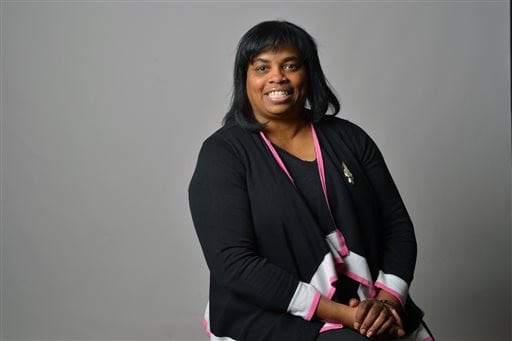
CAROLYN ROBBINS, The Republican
SPRINGFIELD (AP) — The family story of Jeffrey Brace, who arrived in this country more than 250 years as a slave and went on to fight in the American Revolutionary War, has taken many twists and turns as his descendants put down strong roots in Vermont, Connecticut and Massachusetts.
Now Rhonda Brace, 53, of Springfield, the great-great-great-great-great granddaughter of the man who was taken by English slave traders from the shores of the Niger River in West Africa, will take the stage next week in London as part of a panel discussion on the ongoing fight against slavery around the world.
It was a journey she could never have imagined a decade ago when the Brace family first discovered its connection to Jeffrey Brace who settled in Vermont as a free man, raised a family and penned a slave diary in the early 1800s that is now part of the special collections library at the University of Vermont.
The name Jeffrey was a common one through several generations of the Springfield branch of Brace family.
So when a local customer of Jeffrey S. Brace Jr., a former employee of Yale Genton — and Rhonda’s uncle — saw an article about the slave diary in a Vermont newspaper, he brought it the family’s attention.
Later the family connected with Kari Winter, a professor of African-American studies at the University of Buffalo, who helped authenticate the Brace’s direct ties to Jeffrey Brace.
The Springfield Brace family has since connected with the Vermont branch of the family with one of the Green Mountain state members hosting a family reunion attended by a busload of folks from Springfield.
Now the whole Brace clan knows of its connection not only to the slave diarist, but to another ancestor, Jeffrey’s great grandson Peter Brace who fought in the American Civil War in the African-American 54th Regiment from Massachusetts.
Jeffrey Brace, who secured his freedom after fighting in the Revolutionary War, had gone blind by the time he began to write his memoirs, “The Blind African Slave,” so he dictated his story to Benjamin Prentiss, a white abolitionist lawyer.
Rhonda Brace, who confessed that she was bored by history when she was a student, is now immersed in the history of her family with its roots dating back to the founding of the nation.
The story inspired her father, Ronald N. Brace, to help form an African-American Civil War re-enactor’s group, called the Brace Brigade — after Peter Brace, the Vermont Civil War veteran. The group will be appearing in South Deerfield over the Fourth of July weekend.
She has read and reread Jeffrey Brace’s memoirs dozens of times, and is constantly moved and inspired by his story. “There’s a certain angst you experience when you know this happened to someone in your family,” she said.
Brace said she looks forward to sharing her family’s story at the first global conference on Slavery, Past, Present and Future, which will be held July 7-9 at Mansfield College, Oxford University. And she wonders what other discoveries she might make at the event.
The narrative, which was first printed in 1810, is particularly rare because Jeffrey Brace’s story begins in Africa where he was captured at the age of about 16 and recounts what life was like in the kingdom of Bow Woo, its climate, customs — and the fateful day when he was kidnapped by English slave traders as he headed toward the Niger River in West Africa for a swim.
Rhonda Brace and family members learned of Jeffrey Brace’s life as a slave in Connecticut where one of his owners, Mary Stiles, taught him to read.
“She introduced him to the Bible,” Brace said. “He could quote Bible verses verbatim,” she said.
Winter, who unearthed the diary from the library in Vermont, has also befriended the Brace family. Winter, editor of the 2004 reprint of “The Blind African Slave,” had been searching for the Brace family for six years before finding what she called the story’s “missing link.”
Winter will accompany Rhonda Brace and appear on the panel with her at the slavery conference next week. The conference is being organized by Inter-Disciplinary.Net.
Brace said participants at the conference will be from around the world, including some living in places where slavery is still a fact of life.
Writing about the conference on its website, Inter-Disciplinary.Net says, “The 2014 United States State Department’s Trafficking in Persons Report, for example, claims that virtually every country in the world is now a source, transit, or destination point for human trafficking, which it describes as a ‘modern form of slavery.'”